State of Education report
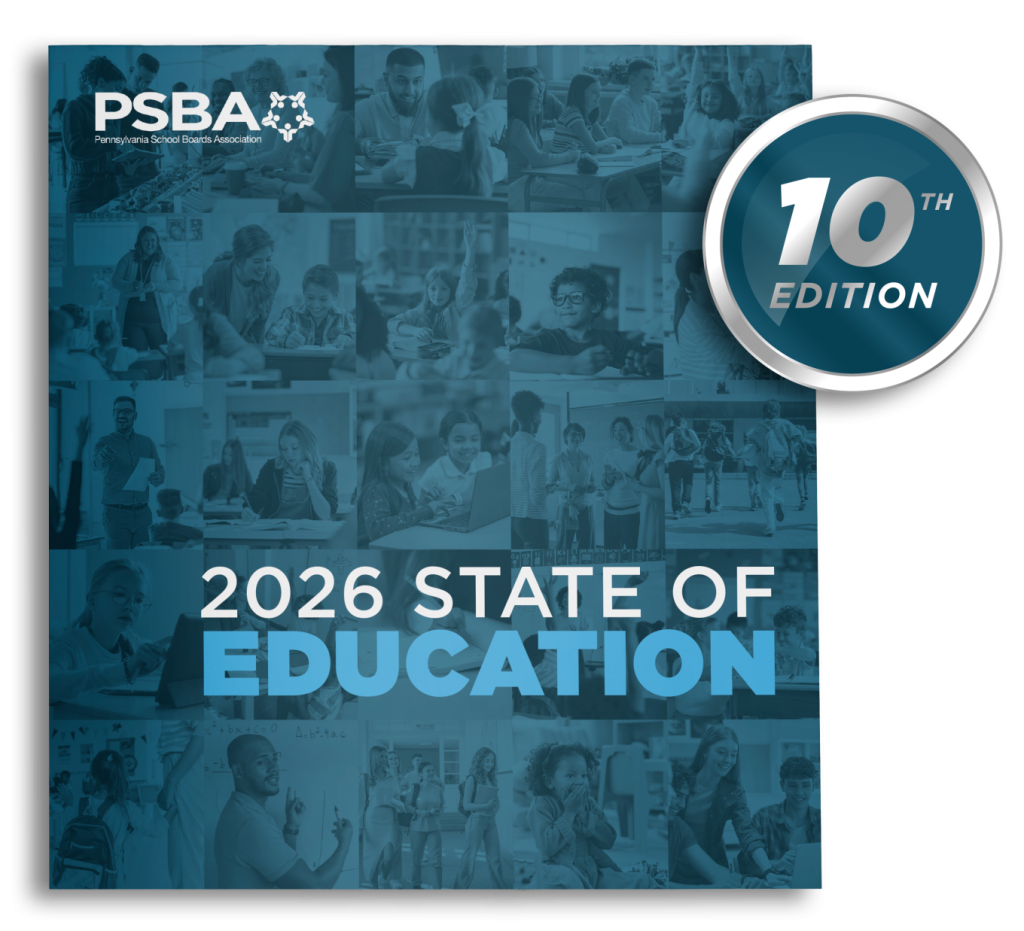
Since its launch in 2017, the annual State of Education report has served as a key benchmark for understanding the condition of Pennsylvania’s traditional public schools. It tracks essential indicators — such as student achievement, school finances and staffing — while also identifying emerging challenges and the strategies districts use to address them.
The report provides a high-level overview of public education across the commonwealth, with additional analysis highlighting differences among rural, urban and suburban districts. This year’s findings draw on two primary sources: a survey of chief school administrators (CSAs) and publicly available data from organizations including the Pennsylvania Department of Education (PDE) and the National Center for Education Statistics (NCES).
Key indicators examined in this year’s report include student achievement, school challenges, finances, artificial intelligence, student mental health and staffing.
The 2026 State of Education report’s most significant findings include:
Mandated Costs Continue to Shape District Budgets
School districts across Pennsylvania continue to face significant financial pressures from mandated expenses. For yet another year, charter school tuition payments remain the most commonly cited budget strain, followed closely by rising special education costs. These two areas consistently top the list of challenges districts must manage, even as recent state-level reforms begin to ease some of the burden.
Health insurance costs have also climbed to their highest level of concern since this report began, adding to a long list of financial pressures that include facility needs, inadequate state funding, salary increases, inflation, pension obligations and uncertainty around future funding levels.
While these challenges remain substantial, the landscape is beginning to shift. The latest state budget included the most significant charter reform in more than two decades — progress driven in part by the insights highlighted in this report and the sustained advocacy of school leaders across the commonwealth. The data in this section helps illustrate why those reforms were needed and why continued attention to mandated costs remains essential.
Increases in Mandated Costs Contribute to Reliance on Local Funding
The impact of increases in mandated costs – particularly pension, charter school tuition and special education costs – on local taxpayers and students becomes clearer when comparing the state and federal revenues intended to help cover those expenses with the actual increase in those mandated costs. Combined, those three mandated costs have increased by more than $6.1 billion over the last decade, while state revenue intended to help pay those costs has only increased by $2.0 billion – leaving what we’re calling a “mandated cost gap” of more than $4.1 billion.
Even if every dollar of recent increases to Basic Education Funding (BEF) were to go towards the mandated cost gap, those increases would only cover a little more than half of the gap, leaving another $1.7 billion for school districts to pay for out of local funds or other budgetary changes such as program cuts, delayed renovations to school buildings, postponed curriculum or technology upgrades, and/or leaving open positions unfilled.

The Keystone Education Report is a dynamic program produced by the Pennsylvania School Boards Association (PSBA) that brings together the voices shaping public education across the commonwealth.
The March episode, airing on PCN on March 18 and 25, highlights PSBA’s State of Education report and features two members of PSBA’s Government Affairs team: Chief Advocacy Officer Kevin Busher and Senior Director of Education Policy Andy Christ. The episode will also be available on PSBA’s YouTube channel beginning March 20. Below are clips from the March episode.
Special Education: Growing Needs, Growing Costs
Pennsylvania’s special education population has been steadily rising. Over the past decade, the number of students receiving special education services has grown by more than 28%, reaching over 347,000 students in the 2024–25 school year.
At the same time, the cost of providing these services has increased far faster than the funding available to support them. Since 2009–10, special education expenses have more than doubled, while state and federal funding has grown by only 21%.
Together, these charts show a clear trend: as more students require special education services, the financial pressure on school districts continues to intensify.
Student Mental Health Remains a Leading Challenge
For the fifth year in a row, student mental health concerns are the most frequently cited instructional challenge in Pennsylvania’s public schools. More than two‑thirds of school leaders (68.2%) say these issues continue to affect learning.
While still the top concern, the share of districts reporting mental health as a major challenge has declined by nearly 18% since 2022 — showing gradual progress even as needs remain high.
About half of respondents also pointed to family and community factors, such as poverty, along with student attendance problems, as significant barriers to learning. Together, these challenges highlight the complex factors shaping student success in classrooms across the state.
"We are asked to do more and more beyond teaching."
- Survey Respondent
Member districts: Request additional copies of the report
PSBA member districts can request up to 10 additional copies of the report. Please request additional copies using the form at the link below and a member of our team will work to address your request in a timely manner.
Have questions or want to learn more?
If you’re a PSBA member and want to talk through the report or ask questions about its findings, our Government Affairs team is available at governmentaffairs@psba.org.
Members of the media who are looking for more information or hoping to connect with staff who can speak to the issues in this report can reach out to mackenzie.christ@psba.org.